Startups that earn press coverage in their first year grow 3.5× faster than those that don't, according to a 2023 Semrush study of 1,000 early-stage companies. Yet 78% of founders have never pitched a journalist. The barrier isn't access — it's knowing the right approach.
Dmitry Dragilev used PR outreach (zero paid ads, zero agency) to build Polar Polls to 40M pageviews, which led to Google's acquisition. He then applied the same approach at JustReachOut, Smallbiz.Tools, and SERP Gap Analyzer — all acquired. This guide is the exact playbook across those 4 exits.
How do you do PR for startups?
For starters, you don't hire an expensive public relations agency.
They cost you a ton of money - more than what you will spend if you build your own media relations. They also cost you a ton of time that you waste explaining your product, service, story, and mission to the PR experts - without them being able to grasp the message in its entirety.
What's more frustrating? They also try to dissuade you from reaching out to top media people, highlighting why it can be tough for a small business owner, like you, to grab the attention of a big journalist.
In short: They can't get the job done. But you can and do it way better.
This translates into one action: STOP trying to hire the right PR agency and START doing press outreach yourself.
To do PR for Startups, use this straightforward process:
- Nail your One Sentence Value Prop
- Create a Contact List of Relevant Journalists
- Find Email Addresses of those Journalists
- Connect and Network with Journalists
- Write a Banging Email Pitch
- Track your Email Pitches
- Improve your Pitches based on Open and Response Rates
- Follow up with the Journalists
- Prepare your Site for Media Coverage
- Perfect your Landing Page
The truth is that PR for startups is similar to building relationships with customers, its' important work which takes time and effort but has a HUGE ROI.
I've done my public relations for 13+ years, published 1400+ articles and got a startup acquired by Google by employing unconventional PR methods. These days I run a software company which helps businesses pitch journalists and get featured in press all on their own.
Why do I do this? Because I don't want startups to hire PR firms or just send a press release. I want startups to learn the skill of effective Public Relations themselves.
Each and every entrepreneur should find journalists who are interested in their story, on their own, instead of hiring expensive PR firms.
In this article I show you how to do your own PR for your own startup without having to use any tools except Google.
Ready? Let's roll.
[take title="Dmitry's take"]
This article will give you the info you need to do PR outreach and get press for your startup. The process is manual and takes a lot of effort and time (just like anything good in life!)
If you want to kick it up a notch and save time as you automate your PR outreach and learn how 5000+ business self taught themselves how to get featured in press, check out JustReachOut - our DIY PR tool which not only teaches you how to do PR outreach but actually allows you to do the outreach and get featured!
[/take]
[toc]
1. Nail Your One Sentence Value Prop
If you're learning how to build a strategy for your startup, your first step should be to figure out your value proposition.What's that? A value prop is what you do that sets you apart from competing products. You should be able to answer what you do in 1 sentence. Use this template below:
My Company <name> is developing <offering> to help <target audience> <solve a problem> with <a secret sauce>.
Courtesy of Adeo Rossi of Founder Institute this template is pure gold. I've been using it for years. Just fill in the blanks and keep all the jargon away. Let's look at a few examples of one sentence pitches utilizing this template:
Soylent: Never cook another meal or buy groceries again.
Airbnb: Stay in other people's houses and apartments when traveling.
In both of these cases, you instantly understand what they do without having to think too hard.
Now let's look at the following:
We are a web analytics platform designed to give you business intelligence to close your next deal.
Umm, huh? What do they do?
When you are working on your one sentence pitch think about how a journalist is going to imagine themselves in the scenario you present with your pitch. Do they cook their food a lot? Can they imagine themselves never cooking again? How would they react to this? If you were in their shoes what would you say?
I recently listened to a great webinar from the guys at Digital Third Coast which quoted a great book Made To Stick: Why Some Ideas Survive, and Others Die where they break down how to do PR for startups with the following questions:
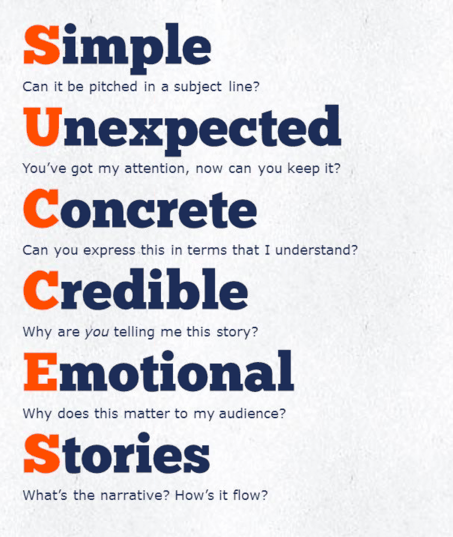
I like to adopt the one sentence pitch to the reporter I'm pitching, in other words not just:
"We're the fastest & easiest way to deliver anything to any location."
but instead:
"You've tweeted about this before, sound familiar? Crap, you really need this package delivered by tomorrow, but you're stuck at work, and there's no way you'll make it to the post office in time. Enter X."
See how this story flows like water, and it's so easy to imagine yourself in this situation?
A great story sticks in someone’s memory much longer than generic explanations of what you do. The longer you can stay sloshing around in a journalist's brain, the better the chance they will remember you when they plan to write a story about a related topic. Master storytelling and doing PR for startups will come naturally to you.
2. Create a Contact List of Relevant Journalists
In this step, you have to find reporters whose main beats include what your product/app/service does.What space is your company in?
Use the following formula:
(descriptor) + (noun)
Noun: Think about the main action your service/product facilitates or performs. Is it sharing? Is it delivery? Or is it coworking? Descriptor: What is its one main distinguishing feature.
Examples:
Product: car sharing app Space: peer sharing
Product: travel concierge service Space: personalized travel
You should know the space you are in so we won't spend too much time discussing how to identify that. Go ahead and type in the space your company is in into Google and toggle to the News tab.
Why Google News tab? Because the people who recently wrote stories about your industry/space are most likely interested in what you do. Alternatively, you can type in the name of one of your competitors.
Google News will show you the most recent articles written on your topic. For example, since my topic is "PR for startups" I would type that into Google News and here is what I get:
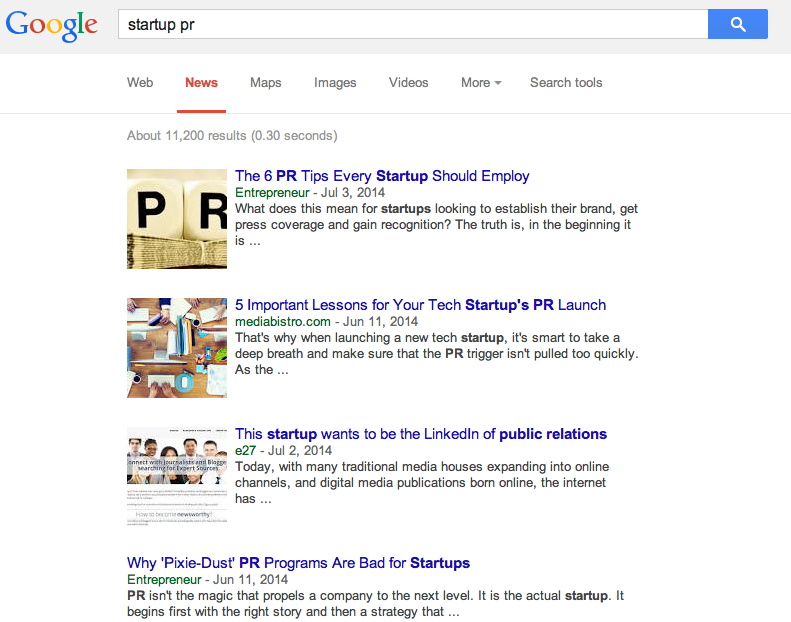
The quality of Google results is not always great. This is what inspired me to build JustReachOut. It's a service that returns much more relevant journalist matches. It also helps you figure out how to do your PR by walking you through a killer email pitch.
At this point, you should have a list of articles written about your keyword, your space, your industry, your competitors. Add the links to these articles into a Google Spreadsheet.
In the spreadsheet make sure you have the following columns:
- Full name of the reporter
- Date of the article
- Link to the article
- Link to the Twitter profile for the reporter
- Any link to the personal website or blog of the reporter (if available)
Now I am a little lazy, so I tend to put a lot of information into the notes section, here is how my version looks:
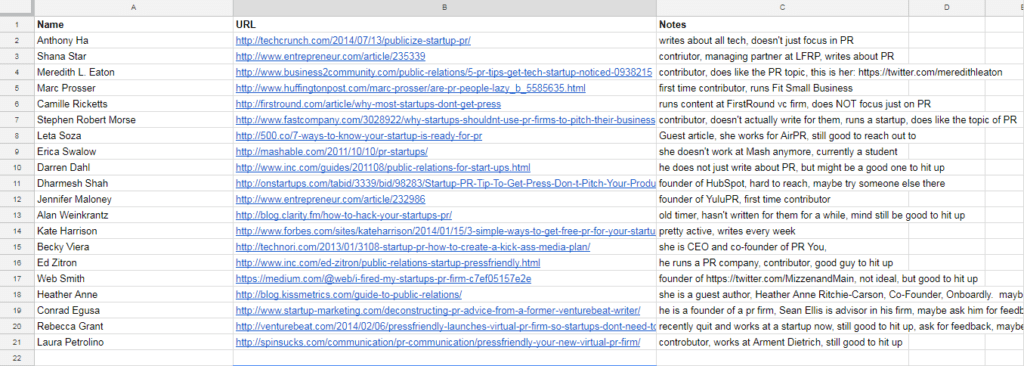
I like to have at least of 20 reporters in the spreadsheet, so I never run out of targets to contact. This may take a little time, but it builds the base for good PR.
Fill out the spreadsheet with the details just like I did by researching every article and the person who wrote that article. Leave the email column blank for now. We're going to guess them in batches later.
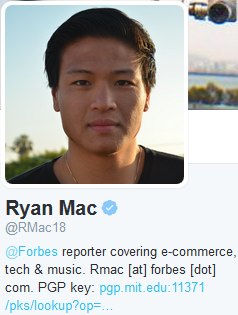
When going through each article, click through to the journalist's social media profile. Only if they cover your field on a regular basis (you see multiple articles written by them on this topic in the last month or two) go ahead and add them to your spreadsheet. For instance, Inc contributor Ed Zitron has written many articles on PR strategy for startups. So, I added him to my spreedsheet:
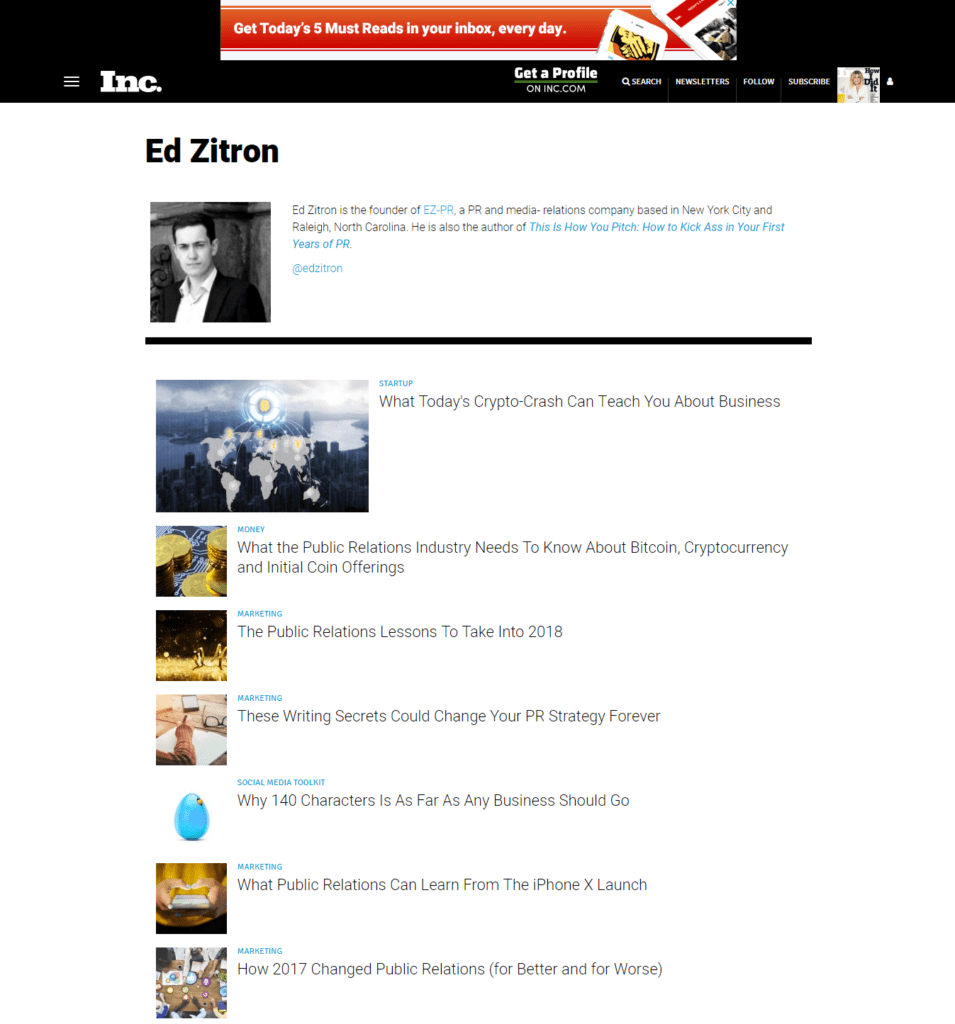
If the article was just a one-off, chances are they may not cover this topic again so it may not be worth the effort to add them to your hit list. BTW some journalists include their email in their social media bios, so it helps a lot to check their bios thoroughly. Giving this part of the process sufficient time is a good strategy.
If they link to a personal website, make a note of it in your spreadsheet. I'll go over where this comes handy shortly.
Keep in mind there are different types of media outlets and blogs, so you want to make sure you categorize each publication in your Google doc.
Here's the hierarchy of publications and blogs from most authoritative and thus toughest to break into to the least (courtesy of Austen Allred). As you can see, at the very top of the press pyramid are mainstream media companies. Further down are industry and mid-tier blogs. At the bottom are personal blogs.
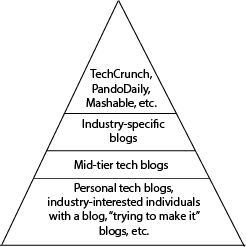
It is useful to categorize the reporters and media companies in your hit list so you know how hard it would be to reach them.
Quick tip: While we’re talking about categories of blogs - do not exclude local media outlets from your hit list.
It is much easier to break into local media companies because the mere news of your firm is relevant for your local city audience. When figuring out how to do PR for startups, explain how the city stands to benefit from your product/service.
For example, your one sentence pitch about your brand might be modified in the following way:
Let's say you're a meal delivery startup, dig up a stat about how many restaurants in your city deliver versus how many that don't and make that part of your pitch.
OK at this point you have a HIT list in a Google Doc of 20 journalists containing the following information for each entry in your list:
- Full name of the reporter
- Date of the article
- Link to the article
- Link to the Twitter profile for the reporter
- Any link to the personal website or blog for the reporter (if available)
As you can see this process take time and effort!
If you want to save time as you automate your PR outreach check out JustReachOut - our DIY PR tool designed to help you automate this very process I describe in this article. 5000+ businesses currently use us to get featured in press daily.
[/take]
Next step is to find their email addresses.
3. Find Email Addresses of Journalists
Finding emails these days is super easy.The first thing to do is Google for your target’s name, use queries like:
firstName lastName + email firstName lastName + contact (PersonalWebsiteURL) + email site:(domain.com): “firstName lastName”
This is the easiest way but may not yield great results.
So we move to the next step which is to guess the email pattern used on a company domain.
Most emails are in the following formats:
firstname@company.com firstnamelastname@company.com firstinitiallast@company.com
For instance, if you wanted to get in touch with John Smith at Tim Hortons, you could try using an email like JSmith@timhortons.com.
Search for the publication on www.email-format.com to find out which format the journalist's email is most likely in:
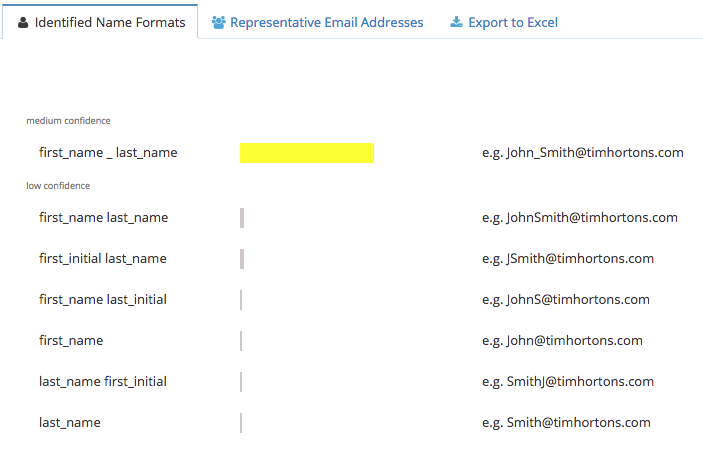
However, this isn’t always foolproof.
To confirm whether you have guessed the right email address use these free tools:
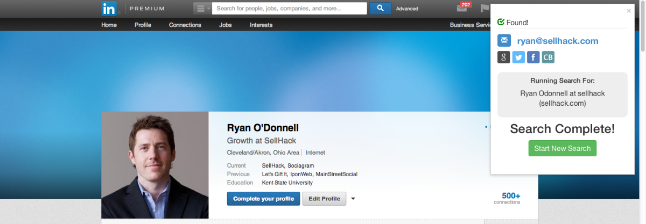
If you'd like to skip the manual work of guessing emails entirely, give SellHack a try. Simply install its browser extension for either Firefox, Chrome or Safari, go to one of your prospect's social profiles and slam on its button. It does all the work for you to find a good email match.
Note: It doesn't work 100% of the time so if it can't find anything, revisit the steps above to unearth a media company's email format.
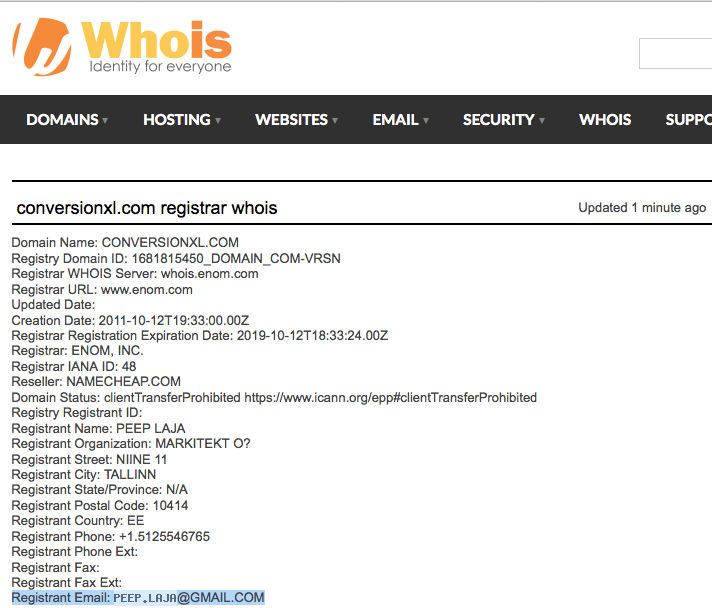
If you have a personal website for the journalist, pop it into WHOIS. In most cases, it returns the personal email address of the site owner.
An email sent to their personal email address has a much higher open rate than one that is sent to their business address where it has to fight for attention amongst the hundred other pitches that flood their work inboxes. This can be a big advantage when you’re learning how to build a PR strategy for small businesses.
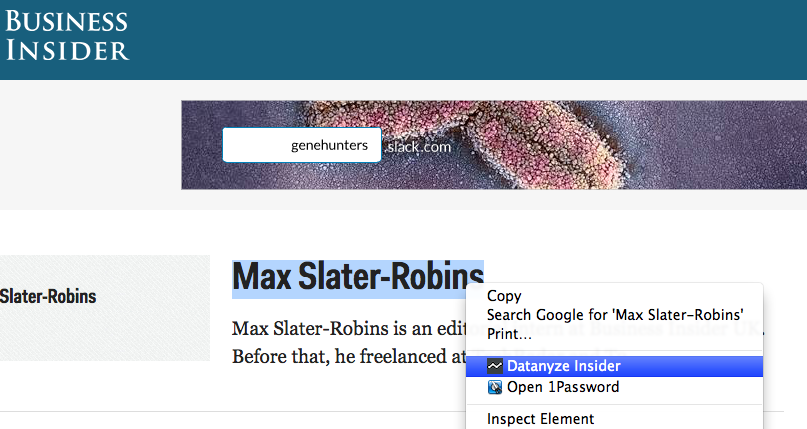
If none of these tactics above worked to help you find an email address go ahead and install Datanyze Chrome Extension and register for an account with them. Once you've got it installed just right click on a reporter's name on the webpage and click Datanyze Insider:
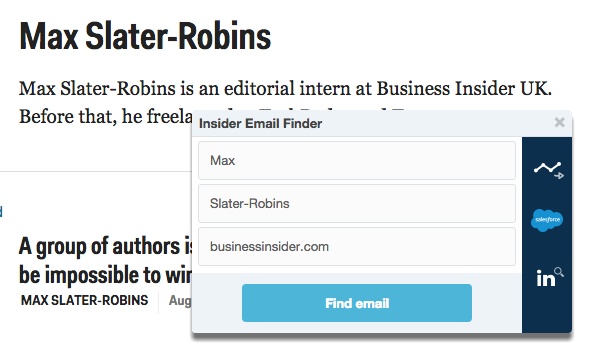
Datanyze pops up a dialog to confirm it has the correct information about the name and the website this person writes for and finds you the email:
Personally, I use a tool called Interseller as well as AnyMailFinder to find emails associated with a domain. Interseller also has a Chrome extension that finds and verifies email addresses in real time against mail servers, crawled sources, and public APIs.
At this point, you have a list of reporters and journalists you want to contact; you have information about each one of them including their contact info. The next step is to get to know each one of your prospects better to be able to write a kick-ass email pitch.
4. Connect and Network with Journalists
You know how sometimes you go to a website and suddenly an ad for it follows you everywhere? In the ad world, that's called retargeting. And the repeated exposure works by subtly worming the company's way into your subconscious. Well, there's a way you can do that with journalists who have previously never heard of you.1. Follow the journalists you want to pitch on Twitter from your personal account.
2. If they ask any questions or share an article, leave a meaningful response that relays one of your personal experiences or an interesting piece of knowledge. Don't forget to inject some personality and humor into it to really stand out!
3. If any articles they share is also relevant to your audience, retweet it. Add this tactic to your to-do list so that you remember to do it regularly.
Any of the above actions should give your email pitch a natural intro - crucial when figuring out how to pitch media.
Here's how Greg Pietruszynski from Growth Bots starts off his cold emails:
I'm Greg (@pietruszynski) from Growbots. We have been tweeting about the article you shared: 'The power of personalization'. I did some research and saw that you may be responsible for lead generation at XYZ, so I decided to get in touch.Following journalists on Twitter and other social media platforms like Instagram also gives you a better idea of their writing style and personality so you can tailor your choice of wording accordingly.
Here's what Rebecca Grant, a former writer at Venture Beat, has to say about building relationships first:
Unfortunately, the relationship usually feels one-sided. You - a PR person, employee, or entrepreneur -reach out to the press when you need coverage. You are asking for a service, for us to pick your story over the dozens of others we could be writing about.
Rarely is that reciprocated. If you have a tip or an idea for an article that *gasp* doesn't involve you, share it with a journalist. We are always on the prowl for good stories.
I love her writing; she has another article that gives PR tips for startups called Tips from a former VentureBeat writer which has some really juicy details in it.
Ideally, you should be laying the groundwork for outreach to influencers and journalists while you're building your company. This way when launch day comes, you have all your ducks lined in a row.
Yes, you're busy. Yes, you have another line of code to fix. And yes you have to move that div by another 1px. But guess what, there will be nobody even to notice the div is off by 1px if you don't have any publicity.
So start compiling a spreadsheet of people you want to pitch as soon as possible so you can start building a relationship with the highest value contacts before your Big Day.
What journalists like receiving without any strings attached:
- Substantive answers to questions they pose on social media/their blog
- Inside scoops about something related to their beat that is going to happen
- Valuable help (example: if they are traveling somewhere, throw together a brief guide for them about the best places to eat/see)
Pro tip: This is how some PR professionals create brand awareness for their clients.
5. Write a Banging Email Pitch
Why and how to do PR for startups over email? Why not Twitter, LinkedIn or Facebook?Growthhackers.com shared a kick-ass study Fractl conducted of 500+ journalists from top sites like BuzzFeed, TIME, Lifehacker, Scientific American, TechCrunch and more about what they want in a pitch.
Here are some key findings:
- 81% of journalists prefer pitches over email
- Most writers publish one story per day, 44% of them get pitched a minimum of 20 times a day.
- 39% are looking for exclusive research to publish
- 64% said it was moderately to very important to establish a personal connection before pitching
- 69% prefer a pitch in the morning
https://www.slideshare.net/slideshow/embed_code/36809274
Think of an angle you can present your company from or a context you can place your company or brand in.
Company: Car sharing app Angle: People are much more comfortable about sharing items with strangers these days Context: Sharing economy
Most journalists don't just write pieces about your company and what it does. That's called...an ad. What they will do is use your company as the jumping off point into a story about the space you operate in or what implications your product/service has for your audience and society at large.
OK, here is the moment most of you have been waiting for:
Email Pitch Templates Which I Like to Use
(some of these come from a dear friend of mine over at ArtOfEmails):Template 1: If your company does work in an exciting space which has been in the news lately
Subject: Re: [The title of their related article from your contact list]Hey X-
My name is [first name] from [company name]. After reading your article [story.title] I thought your readers might be interested to hear more about [topic from their article which relates to what you're pitching] since the subject of [general topic from the article] has been in the news lately. Looking over your past articles, it seems you cover [topic from the article] a lot.
We have some [insert your news/study] which relate directly to your interests. I wanted to send you some info on this topic. Would you be interested?
Thanks,
Your full name
Contact details
Template 2: If your company makes a product that can be used in articles or websites
When I did marketing for Polar (acquired by Google), I pitched journalists on embedding Polar's opinion polls into their breaking news articles to significantly boost their audience engagement. It went quite well; Polar was acquired by Google as a result of this type of pitching. Here is the pitch angle I used:Subject: Got a poll for you: Which Foursquare logo do you prefer?
Hey Chris-
Made a poll for your article asking which Foursquare logo people like the best. Check it, might be fun to get your readers more involved and get more readers to come back to the article: http://polarb.com/polls/194407
Here are how these polls look like live: http://guycodeblog.mtv.com/2014/03/21/vote-favorite-melanie-iglesias-photos/
-Dmitry
Template 3: The personal angle pitch
Got an interesting backstory? Share it. Even if you think you've had a pretty ho-hum life, journalists eat up details like the formative experiences that inspired a startup founder to create his company.Personal details make the perfect hook for articles. Maybe you ran a successful crowdfunding campaign for your first venture in high school? As a founder, if you’ve got a life’s worth of Kodak moments, it really helps the journalist see your story potential.
Subject: Got a good story for your article about the extremes entrepreneurs go (involves not showering much)
Hey X-
Saw on Twitter you're writing an article about the extremes entrepreneurs go to bootstrap their startups.
I've got a good one for you. I actually slept in my car while I ran around pitching investors.
My gamble (and slightly less frequent showers!) paid off. I secured a $100K lifeline, giving my company enough runway to takeoff.
Happy to provide a few solid insights about how to decide if a big sacrifice like this is worth it.
If interested, I can provide the rest of the details,
Thank you.
Signoff
Template 4: The innovative product angle
This angle works if you just launched an innovative technology which solves a complex problem that affects a substantive number of people. By complex problems, think cheap to launch satellites, algorithms to automatically approve/reject small business loans. For instance, your technology enables crowdfunding sites to update their information in real time.If your product is not innovative in this regard, fret not. There are plenty of other compelling angles you can pitch your company from.
Subject: [Just launched] Our software tracks serial killers
Hey Journalist,
Really trust you as the go-to source of nuanced explanations of recent STEM breakthroughs. Liked your recent article on the potential of Theranos to revolutionize blood tests without short shifting the skepticism surrounding its proprietary tests.
I've got another interesting breakthrough for you to chew on. I recently created an algorithm that helps police narrow down where repeat offenders live by calculating distances between the locations of their crimes. My software Rigel assigns the highest probability percentages to areas where the serial killer is most likely to live or hang out in.
Police have used Rigel to help catch serial killers including:
- the Suffolk strangler
- the M25 rapist
- Pickton
- Tracking illegal immigration patterns
Signoff
Template 6: The interesting data angle
This approach works if your data on user behavior gives interesting insights. Develop a script that regularly mines your data trove for trends and see if anything fascinating pops up.Bonus brownie points if you can tease out that a trend runs counter to prevailing wisdom or tackles a hot topic.
Subject: Juicy data about racial bias in dating preferences - interested?
Hey X,
Been following your articles for a while, great insights into social trends.
Your recent article about rising reports of people feeling lonely really resonated with me. I think with the declining popularity of several institutions like the Church that traditionally provided opportunities for people to regular meet; there haven't been many replacements that have brought people together in the same way.
I also have a few juicy social trends to share with you. Our whizzes at OkCupids have been busy crunching some numbers and our data paints a pretty sobering portrait of racial bias in online dating.
The highlights:
- Black women receive the lowest number of messages
- Asian and black men receive fewer messages than white men
- Most races still prefer to date within their race
- Are these patterns played out in real life dating choices?
- Or are online daters, who can 'window shop' a lot more options, more selective?
Signoff
Template 7: Interesting context angle
If your company is working in an interesting or trending space, spell out the connection.For instance, blockchain startups are trending in 2018 because this technology is used as a digital ledger for cryptocurrencies - a very interesting subject for journalists!
While some journalists may not wish to write an article solely about your company, they may mention it as an example of a broader phenomenon.
For example, another hot-button issue right now is online privacy. Let's say you make an IP mask tool. You can bring up people's growing anxiety over who is collecting their data and how it may be being used.
Company: Startup about matching you with a personal tour guide
Context: In the age of mass consumption and automation, people are increasingly seeking one-on-one connections with other human beings and experiences customized to their interests.
Subject: How our product plans to replace food
Hey Journalist,
I've been following your articles for a while - very cutting cultural analyses. Loved your recent one about eating insects as a substitute for meat protein - think all it needs is an image makeover to overcome the ick factor.
Wanted you to introduce you to another food substitute we recently launched - in the form of a nutritional drink. It provides 2600 healthy calories a day and makes eating super affordable and convenient. Step 1: blend with water or milk. Step 2: Drink up and feel full.
For the average four-member American family: $154.62 per month on Soylent versus $584 on groceries.
Interesting angle to explore: Soylent's role in the life-hacking movement.
If this is a good fit, let me know.
Signoff
Template 8: The local angle
As mentioned earlier, local publications are much easier to break into because:a) The limited scope of their coverage means they are always on the hunt for more news, and
b) The addition of your product/service can be relevant and impactful to the community.
When you're doing PR for startups, local publications should be high on your priority list. They are the favorite targets of PR people too.
Frame your pitch from this angle when you're first starting out to get your feet wet and test reactions to your pitch and one sentence hook.
Hey Journalist,
Really interesting coverage about the lax security at VIP lounges. It's that old truism - money talks.
Thought you might be interested in something my team and I just launched. Ever been stuck at work and you've just dying to eat your favorite chipotle taco? But snag, they don't deliver? Well, imagine a world where every restaurant, even your favorite hole in the wall that can barely keep up with the crush, does deliver. We're making it happen! With our team of meal heroes on scooters.
Basically, you call the restaurant to order and then call us to arrange the pickup and delivery: [link]
Let me know if this is a good fit for your audience? We can throw in an exclusive coupon for them - first delivery free. And suddenly a few more people just became the employee of the month at their workplace. :)
Signoff
Relationship building emails
These emails are primarily for building a connection with a journalist. Once you have a connection, you'll find that they are more likely to at least open your email and consider it.Template 1: Giving the journalist a scoop
Subject: Re: Article title they recently wroteHey name #1-
Respect your writing a bunch, I'm an old acquaintance of [insert name #2] of [publication for which name #1 writes for], love your blog and tend to check it every other day. Saw something you'd dig, wanted to pass it on... in relation to your post on webcams from Feb:
http://gizmodo.com/5888244/a-gumby+like-webcam-that-can-be-any-shape-you-need
I saw this little hacking guide/video on how to "actually look good on webcam" which was just published, figured you'd dig, wanted to shoot this over:
http://wistia.com/blog/snazzy-on-webcam/
Curious to hear your thoughts about it. I think they made some great points, right?
-Signoff
Template 2: Typo in their article angle
Subject: Typo in your articleHey X,
Respect your reporting a great deal. Love the stories you put out. [Insert a line about their latest article. For example, Crazy to think that there are more people using mobile vs. desktop now.] Saw that you have a few spelling mistakes in your recent article, wanted to follow up:
"The project, which was was announced"
"The content will be uses for The New York Times"
Looking forward to your next stories. Which article are you working on next?
-Signoff
Template 3: Implementing their advice
Re: Loved your article about radical honesty - here are my results after a weekHey X,
I've been following your blog for the past 3 years, so many great insights!
Your recent post about radical honesty really resonated with me. I followed it step-by-step and I found it dramatically reduced my day to day stress levels.
You can read my post about it here: URL
If you're so inclined, I'd love for you to share it with your audience.
Thanks for sharing your can't-find-anywhere-else tips with the community.
-Signoff
[take title="Dmitry's take"]
Finding relevant journalists on autopilot is sometimes tough as you can see. Takes a lot of time to do the research.
We built JustReachOut - our DIY PR tool to help businesses automate this very process I describe in this article. 5000+ businesses currently use us to get featured in press daily.
[/take]
6. Track your Email Pitches
There are several tools to track your emails to see if the journalist has read your email or clicked on your link. My favorite is MixMax for Gmail. It works like a charm and the free plan includes unlimited email tracking!I can set the default setting to track all the emails I sent out. Or I can select the individual emails I prefer to track:
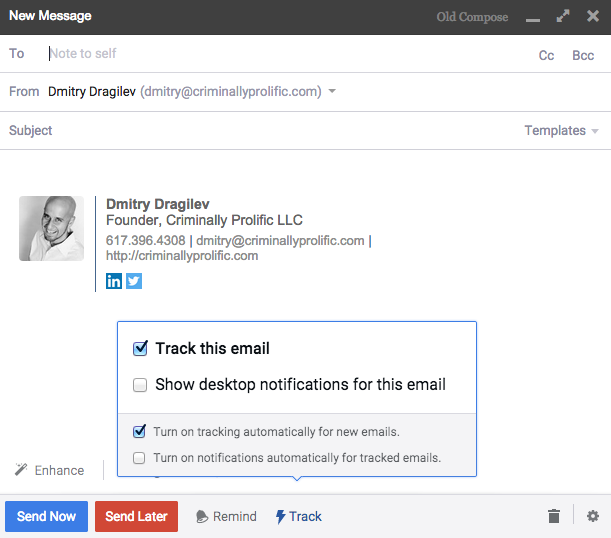
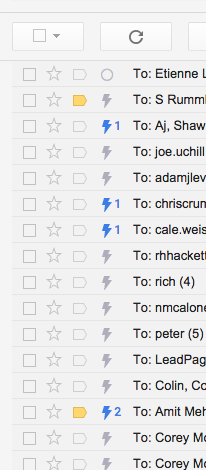
Email tracking is extremely useful when doing PR for startups. I can then just search for email or go to my sent folder to see if anybody has opened it or read it. The lightning icon with a number next to it indicates someone has opened it and the number of times they opened it:
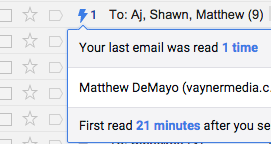
I can click on the lightning icon to find out the details:
Some other good alternatives are YesWare.
7. Improve your Pitches based on Open and Response Rates
You should start by pitching to lower traffic publications to perfect your pitch first. Continually tweak the following parts of your email:- your subject line
- how you describe your differentiating factor
- the angle you pitch from
8. Follow up with the Journalists
I'd say 90% of responses I get from journalists are to follow up emails I send.This is the most important step in a PR program and should be part of your core press strategy.
Some journalists who are intrigued by your pitch may not act immediately. You must follow up! Check your email tracking logs. If a recipient opens your email 2-3 times, it generally means they have some interest in your pitch. In this case, send them a follow-up email 3-4 days after your initial one. Say something simple like:
"Hey
We just did [recent interesting development].
Let me know your thoughts about [our company]?"
9. Prepare your Site for Media Coverage
If you get coverage, depending on the media outlet, prepare your site for a deluge of traffic. If you have hired an agency to handle your site give them a heads up.1. Make sure your site is hosted on a dedicated server or a cloud hosting service. 2. Use Cloudflare. Add a line of script to your site and it automatically minifies your javascript files and caches your files so your site loads a lot faster. 3. Email your host. This is one step that a lot of people don't take. If you're about to get hit with some serious traffic, shoot an email to your web hosts and see if they can help you at all by allotting your site more resources. 4. Minify your images. Minify all your images to its lowest possible size without severely impacting quality.
When one media outlet covers you, it not only gives you a lot of social proof but helps you be discovered by other journalists as well, kicking off a snowball effect (hopefully). Make sure you have your contact info prominently displayed on your front page so other people can easily email you.
10. Perfect your Landing Page
Nothing worse than getting lots of press mentions and getting that dreaded 99% bounce rate. Get Optimizely to A/B test your landing pages to see which copy is more effective at getting your audience to take the desired action.Also, your design approach strategy should be to stick to a “one page, one conversion goal." As in, your landing page should focus primarily on guiding your visitors to perform one action - whether it be downloading your app, signing up for a trial or leaving their email. One action.
So as you can see...
How to do PR for startups is a complicated process. But it’s doable.
There are many, many angles from which you can present your company to get press mentions. Whether you are in a boring industry or your company is the hottest tech startup in the Silicon Valley, you need to go through all these steps to build a successful PR campaign.
The beauty about taking control of your PR outreach is, you know exactly who is responding, what is working and what isn't. Instead of waiting for your PR firm to circle back at the end of the month with "we're on the cusp of a breakthrough if you just stay with us another month".
The other beauty of running your own PR outreach is after you finetune the process to the point it starts to reliably deliver results, you can automate many parts of it. For example, you can get a virtual assistant to populate those press contact lists.
Once you have sent several pitches that have gotten good open and response rates, you can simply start tweaking and re-sending that same winning template over and over again.
Ten PR tools for Startups
PR tools make it far easier for you to execute all these media relations activities. Rather than try to build relationships and pitch journalists manually, use tools to do PR at scale.I have tested and selected 10 tools for startups. These have worked GREAT for me in 2018 and I will use all of these more in 2019.
1. JustReachOut
Doing PR Outreach on your own can be tricky. You might need to buy a bunch of PR tools, and somehow make them work together.That’s why I built JustReachOut to help you. You see, being a founder of a successful startup myself, I know how precious your startup can be and the importance of nurturing it at an early age.
JustReachOut believes in being a total solution provider and provides the tools and expertise required to give you the early media coverage “boost” that your startup needs.
We pride ourselves on combining two of the most powerful tools to help spread your message- a robust PR software and a team of expert outreach strategists.
Don’t just take our word for it. Here is how we helped Aleh Manchuliantsau feature his small food company called Planetarians feature on the ABC News!
How do we do it?
We start, of course, with your PR goal. What exactly are you looking for and how we can help you achieve that.
What do our happy customers sign up for? Well the list is exhaustive, but some of the things that we help out with are:
- General Exposure
- Driving app installs
- Customer acquisition
- Guest post-publication for establishing a brand/image
- Kickstarter funding goal, and being kickass
- Retail sales
- Search Engine Optimization/ backlinks and other big scary words that you always wanted to try.
We regularly work with marketers and founders to identify the assets that they need to focus on to achieve their PR goals. This can range from content, reports, and surveys that might be relevant to the journalists that we are pitching the idea to.
Now comes the fun part. Identifying those ever elusive journalists who are relevant to your business and telling them your story.
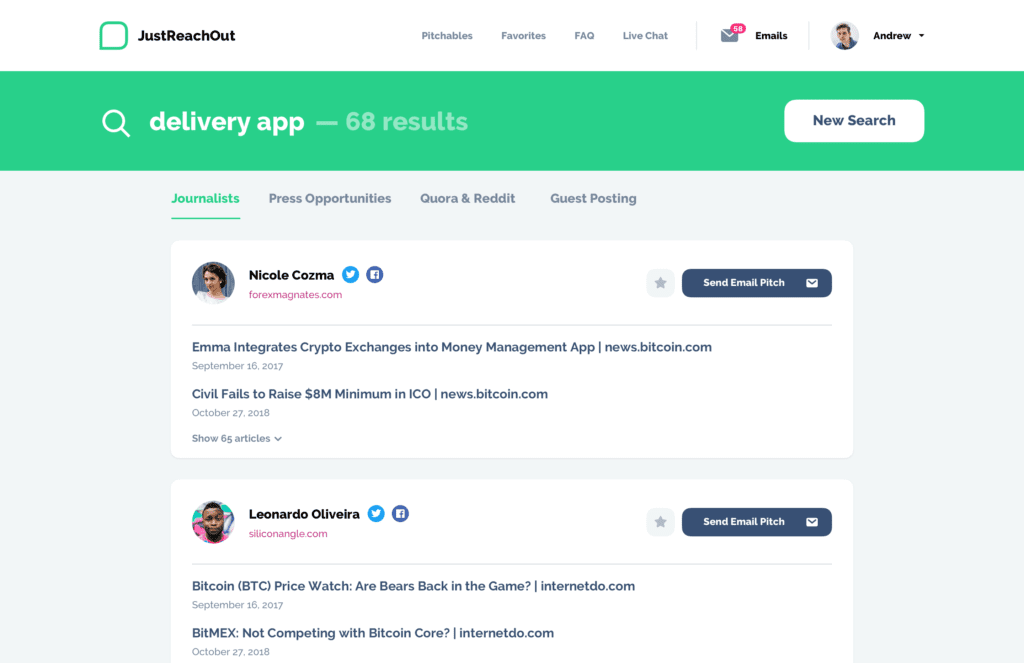
We do this using our sophisticated JustReachOut software. This little baby indexes millions of pages containing articles written about a specific trend, topic, niche, industry or company. From there, it extracts the name of the author, the related article and available social media links, which helps us build our database.
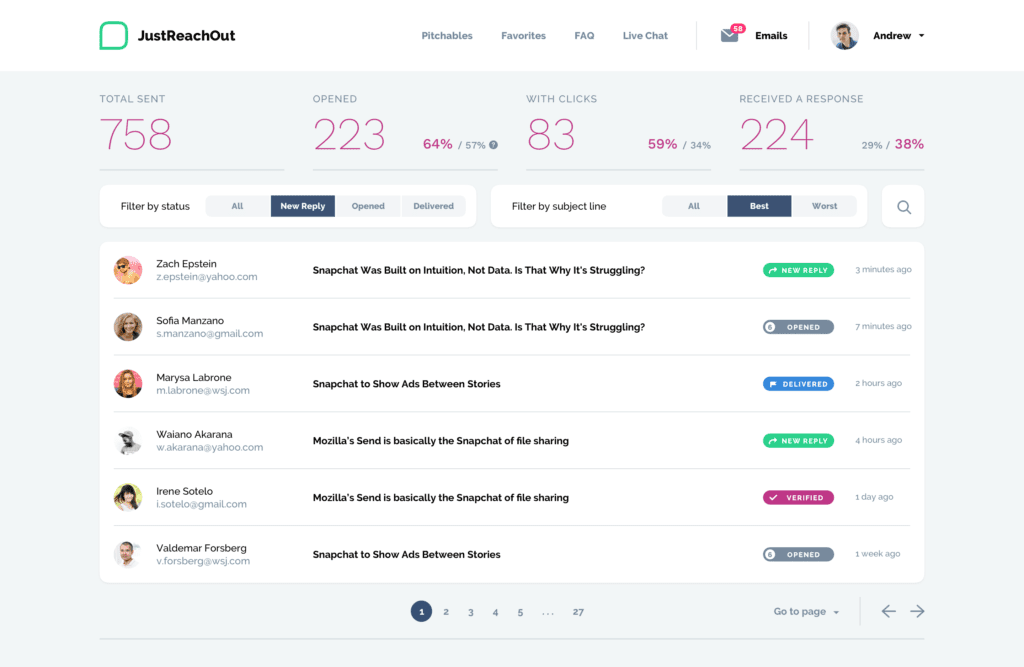
So now, all you have to do is search for a specific topic and our software lists out all the relevant journalists for that topic based on their past writing. Not only that, but the software also monitors daily press opportunities on sites such as ProfNet, Reddit, and Quora to find the right fit for your business.
Ok, so you have found a bunch of journalists who will be interested in your story and are now ready to send out those lengthy pitch emails that you always wanted to send, right? Hold your horses.
JustReachOut helps you find the specific reasons why a journalist will be interested in your story. We then help you write conversation starters, email pitches and follow up emails, thereby helping you build meaningful relationships with these influencers and bloggers. So when you are telling your story, they are more than willing to hear it.
The software also provides a customizable view of pitch analytics, showing you how to adjust the email pitches, subject lines and overall action plan.
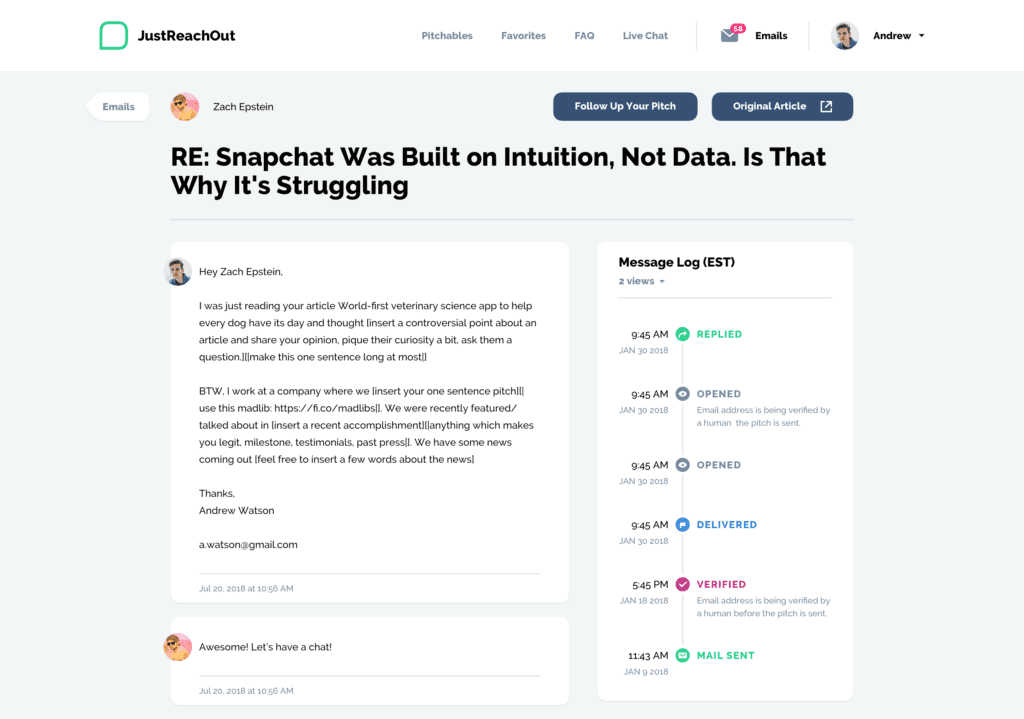
So we help you write your first email, revise and optimize your pitch, and come up with new pitch angles. And then?
We do a little magic trick. Pull out our invisibility cloak and slowly disappear.
See, we are not just another PR agency on which you will have depend for your PR success forever.
We give you the initial training, introduce you to the tools so that you can monitor and independently control your campaign, soak up insights from our most successful customers so that you move on to a self-service mode.
Ready to experience the magic in your PR efforts? Schedule a demo.
Quick Tip: The tool shows you the most popular and relevant Reddit and Quora discussions. You can significantly increase your exposure, just by leaving a comment.
Pricing: Plans start from $697/month for a single user.
2. ANewsTip
While Google might be helpful in finding relevant journalists - it really can't help you find their contact information.We can consider ANewsTip as ‘Google for PR Outreach’.
The tool is really simple. Just enter a keyword, for example - ‘dogs’.
 With the search results, you can identify journalists who might be an expert in your category.
Once you find a relevant journalist, you can get to know:
- Contact information.
- Latest tweets.
- Previous articles.
- Similar Journalists.
Quick Tip: ANewsTip has preset contact lists that you can instantly use to connect with journalists in your niche.
Pricing: Plans start from $200/month for one to five users.
3. HARO
Instead of reaching out to journalists, why don’t you let them come to you?HARO provides an alternative to PR outreach.
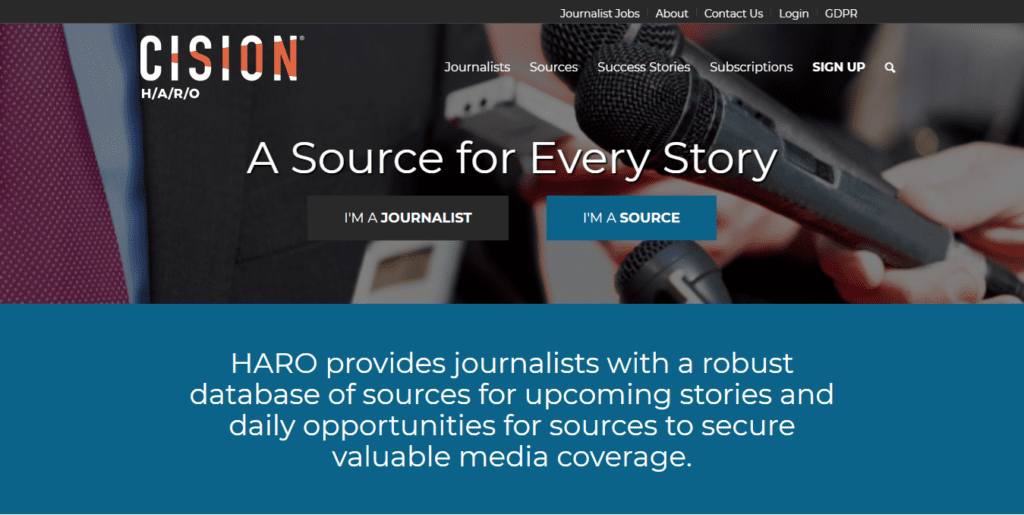
Reporters are always looking for expert sources that can help them with their article.
For example - A reporter needs to write an article about ‘Content Marketing’. He creates a request for quotes or tips from experts on HARO. You then receive a request for a source, along with a few questions.
In response, you can send an email answering all of their questions. This gives you a chance to be featured in their article.
Quick Tip: Make sure to include your bio and contact information in your response email - so you can communicate with them in the future.
Pricing: Plans start from $19/month for a single user.
4. SparkToro

You might be churning out of a lot of content - but getting little to no results.
One of the main problems behind this is that many of your articles and press releases may not connect with your target audience.
Before you even begin your PR efforts, you need to know your audience.
A few relevant content pieces deliver more value to your readers than random news articles.
They help you increase your engagement with your audience to a point where you can have loyal followers!
SparkToro is an upcoming audience intelligence software from Moz founder, Rand Fishkin, that helps you identify what exactly your audience likes.
It could be the podcast they listen to, blogs they read, what influencers they follow, whatever - this information helps you create shareable and relatable content.
Quick Tip: While Sparktoro is currently under development, you can use a few free tools from the website including Fake Followers Audit, Trending, and SparkScore.
Pricing: NA
5. Google Alerts
Sometimes, the best way to be heard is by piggybacking on significant trends.As a news story trends, more people use similar search keywords to learn more about it. Use this opportunity to publish a relevant article.
More search traffic means more views and higher engagement.
Track these trends within your industry through Google Alerts.
For example - If you own a pet grooming business, enter a relevant keyword into the Google Alerts search bar. Let’s say - ‘dogs’.
You instantly receive the top news stories and trends about dogs. Use this information to generate ideas for your next blog post/press release.
Quick tip: You can set up daily email alerts for any keyword of your choice.
Pricing: The tool is free to use.
6. Business Wire

Let’s face it - there is an insane amount of content online. Almost every brand has a blog, press coverage, and social media posts.
Your press release might drown in the sea of digital media.
What can you do so that your audience gets your message?
For starters, you can pitch your release to a wide range of media publications and websites.
Business Wire does this for you automatically.
With an impressive network of 89,613 media outlets in 162 countries - Business Wire makes sure that your company announcement is heard.
Quick Tip: You can monitor how well your press release is faring through the ‘Analytics’ feature.
Pricing: An average press release costs around $325 in US metro areas.
7. PRWeb
 Your press releases shouldn’t just talk about your brand. It should drive conversations.
What better way to get people talking about your brand than Social media.
PRWeb is a press release service with a focus on new media (blogs, social media, etc.)
What makes PRWeb different from other distribution networks is that it’s incredibly customizable.
With a few clicks, you can upload your content, add photos and videos, including social media links and quotes.
PRWeb’s distribution network delivers your story to around 1200 websites, journalists, bloggers, and social media influencers.
Quick Tip: You can measure the impact of your press releases with stats like click-through traffic and social media shares.
Pricing: Basic plan starts at $99 per news release.
8. Prowly
 Having a solid brand entity is crucial.
According to Reuters, 82% of investors believe that brand strength is vital in guiding them in their investment decisions.
Creating a professional website is a surefire way for your brand to be recognized.
Prowly helps you build an online newsroom, blog, and website for your startup.
Why are online newsrooms important for your PR efforts?
Press rooms house all your press releases, brand logos, and media coverage. They are a great asset for journalists.
How Prowly’s press rooms help:
- Attracts reporters, which increases your company’s chances of being featured in their articles.
- Gives journalists background information about your company so they can create well-informed press releases.
Pricing: Plans start from $106/month for a single user.
9. Buzzstream
 Don’t just rely on journalists for your PR strategy.
You can reach out to other bloggers or influencers to help you spread the news about your company.
For example - Let's say you wrote a guide about how dogs can reduce stress. Create a list of writers that might be interested in this topic through Buzzstream.
You can then ask these influencers for a link to your article from their blog. This method helps you get a larger audience…. for free! As a courtesy, you can offer to give them a link back.
Buzzstream helps you create outreach emails (with automated templates) which saves time.
Quick Tip: You can set follow-up reminders, and track progress for every campaign.
Pricing: Plans start from $24/month for one to fifteen users.
10. Cision
If you are ready to invest heavily in your PR efforts - you shouldn’t be afraid to bring out the big guns.
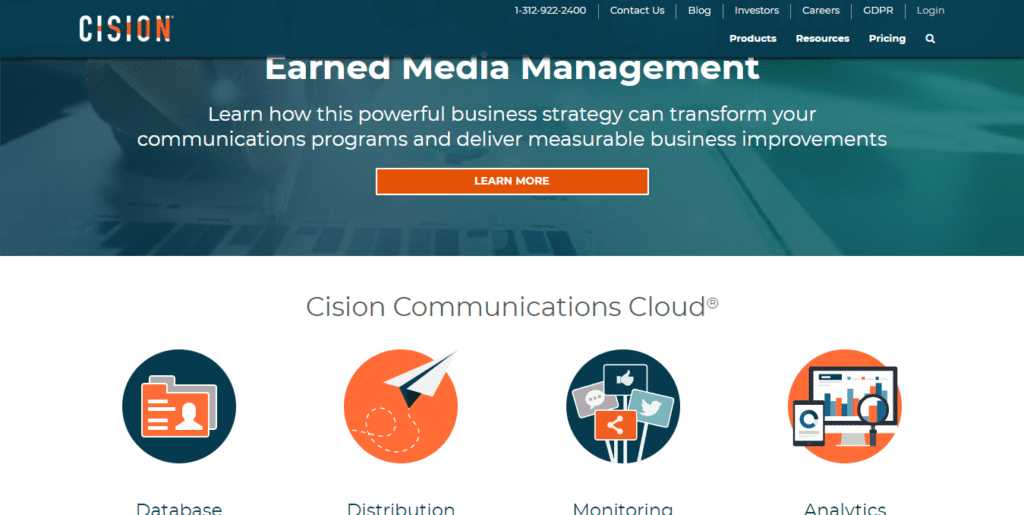
The Cision Suite is a high powered PR software that can help you manage your entire campaign from start to finish.
For the research phase - You get access to a database of approximately 1.6 million journalists, editors, and influencers.
For the distribution phase - Distribute your press release through Cision’s PR Newswire which is connected to digital media powerhouses like The New York Times, ABC News, Yahoo! Finance, MarketWatch and more.
For the analysis phase - Check out your campaign’s progress, views, engagement and stats through the Analytics’s Feature.
If you can’t afford the entire tool, you can choose to buy a few features that suit your PR needs.
Quick Tip: The Analytics and Reporting feature gives you valuable insights to show what content works best for your company.
Pricing: Available on request (though you can expect around $5,700 annually).
Over To You
There you have it. This is the exact process I follow when I reach out to journalists to get them to cover me.Apply this process, take the time to research and find journalists interested in what you have to say, make sure to go through each step and you'll see success, I guarantee it. I've used this process for 8+ years, gotten startups acquired using this process, and have built my entire business on it.
Happy reaching out!
[take title="Dmitry's quick parting note"]
Would love your feedback as you implement this process. I have followed this playbook for years.
I decided to build JustReachOut - our DIY PR tool to help myself automate this very process I describe in this article. 5000+ businesses currently use us to get featured in press daily. Would love your feedback!
[/take]
Get the full playbook in your inbox.
20,000+ founders read my newsletter on building to acquisition in 3 years, working 3 hours a day.
